
Free Shipping Over $89
Is All Stainless Steel Chimney Pipe the Same? What to Know Before You Buy
06/29/2017
Author: Sean Summers, NFI Master Hearth Certified Technician – WoodstovePro.com
When shopping for stainless steel chimney pipe, many homeowners assume that “stainless is stainless.” In reality, not all stainless steel chimney pipe is the same—and choosing the wrong type can affect performance, lifespan, and long-term safety. Differences in steel composition, corrosion resistance, and intended use matter far more than most buyers realize.
If you’re comparing options or wondering about 304 vs 430 stainless steel, here’s what you need to know before you buy.
Why Stainless Steel Matters in Chimney Systems
Chimney pipe is exposed to extreme conditions:
- High temperatures
- Rapid heating and cooling cycles
- Moisture and condensation
- Acidic byproducts from wood, pellet, or oil combustion
The type of stainless steel used directly impacts chimney pipe corrosion resistance, durability, and overall safety. Lower-grade materials may look fine initially but can degrade quickly when exposed to flue gases and moisture.
Ferritic vs Austenitic Steel: What’s the Difference?
The biggest distinction in chimney pipe materials comes down to ferritic vs austenitic steel - two categories of stainless steel with very different properties.
Ferritic Stainless Steel (430 Stainless Steel)
430 stainless steel is a ferritic grade, meaning it contains iron and chromium but little to no nickel.
Key characteristics:
- Magnetic
- Lower cost
- Moderate corrosion resistance
- Good heat tolerance
Where it’s typically used:
430 stainless steel is commonly used for the outer wall of chimney pipe, where it is not directly exposed to flue gases. It performs well structurally but is less resistant to acidic corrosion.
Austenitic Stainless Steel (304 Stainless Steel)
304 stainless steel is an austenitic grade, containing higher chromium and nickel content.
Key characteristics:
- Non-magnetic
- Excellent corrosion resistance
- Handles acidic condensates well
- Superior durability in harsh environments
Where it’s typically used:
304 stainless steel is the industry standard for the inner liner of chimney pipe because it resists corrosion from creosote, moisture, and acidic byproducts.
304 vs 430 Stainless Steel: Why the Difference Matters
The debate over 304 vs 430 stainless steel isn’t about which is “better” overall—it’s about using the right material in the right place.
|
Feature |
304 Stainless Steel |
430 Stainless Steel |
|
Steel Type |
Austenitic |
Ferritic |
|
Corrosion Resistance |
Excellent |
Moderate |
|
Nickel Content |
High |
Minimal |
|
Typical Use |
Inner liner |
Outer wall |
|
Cost |
Higher |
Lower |
High-quality chimney systems often combine the two: 304 stainless steel inside for protection and longevity, 430 stainless steel outside for strength and cost efficiency.
Why Corrosion Resistance Is Critical
Poor chimney pipe corrosion resistance can lead to:
- Rusting and flaking metal
- Pinholes in the liner
- Reduced draft
- Leaking smoke or gases
- Shortened chimney lifespan
Wood-burning appliances produce creosote and acidic moisture that aggressively attack low-grade steel. Using 304 stainless steel in the liner dramatically reduces these risks and extends the life of your chimney system.
Climate and Fuel Type Also Matter
You may want higher-grade materials if you:
- Burn wood or pellets frequently
- Live in a coastal or high-humidity area
- Use your stove as a primary heat source
- Experience long burn cycles
In these cases, investing in better materials up front can save you from premature replacement and costly repairs later.
What to Look for When Buying Stainless Steel Chimney Pipe
Before purchasing, make sure to:
- Confirm which stainless steel grade is used for the inner liner
- Check manufacturer specifications
- Ensure compatibility with your appliance
- Verify UL listing and code compliance
- Consider your climate and fuel type
Not all “stainless steel chimney pipe” listings are created equal—details matter.
Final Thoughts
So the answer to the title question is, no, not all stainless steel chimney pipe is the same. Understanding the difference between ferritic vs austenitic steel, and especially 304 vs 430 stainless steel, helps you choose a chimney system built for safety, durability, and long-term performance.
If you have questions about chimney pipe materials or need help selecting the right system for your stove or fireplace, our certified hearth experts are here to help. Contact us at 888-418-0005 or info@woodstovepro.com.
Understanding and Calculating Roof Pitch
05/09/2017
Written by Sean Summers, National Fireplace Institute (NFI) Master Hearth Certified Technician - WoodStovePro.com
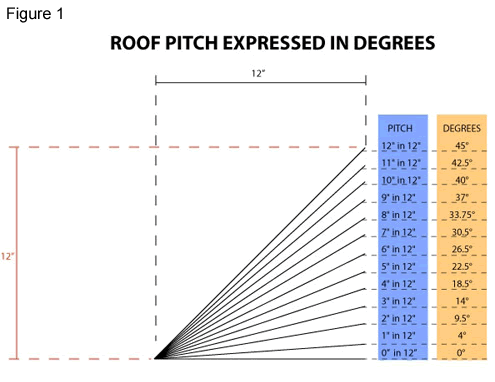
Roof pitch is simply a numerical expression of the steepness of a roof.  In the U.S., this is usually represented by a fraction in which the numerator signifies the rise and the denominator the run. For example, if we have a roof that rises 4 inches over 12 inches of run, then we would denote it as a 4/12 pitch. Pitch can also be expressed in degrees and discussed as an angle (see Figure 1).
 The calculation of pitch is fairly simple. If you have two tape measures, or rulers, you can find the pitch from the rooftop or inside your attic space. Refer to Figure 2 to see how to arrange your tools for measuring pitch.
Please remember to be cautious when working on your roof or unfinished attic space. If you still have questions, please leave a comment or send us an email. We are always happy to help.
The 10-Foot 2-Foot 3-Foot Rule
05/02/2017
How to Determine the Chimney Height Above the Roofline
Questions about this rule come up a lot, and there seems to be a lot of confusion about it. Thankfully, this standard is actually quite simple. In most cases, with just two pieces of information, you can calculate the height of your chimney on paper without ever having to climb on the roof.
 First, you’ll need to know the pitch of your roof.
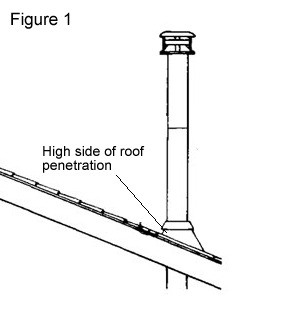
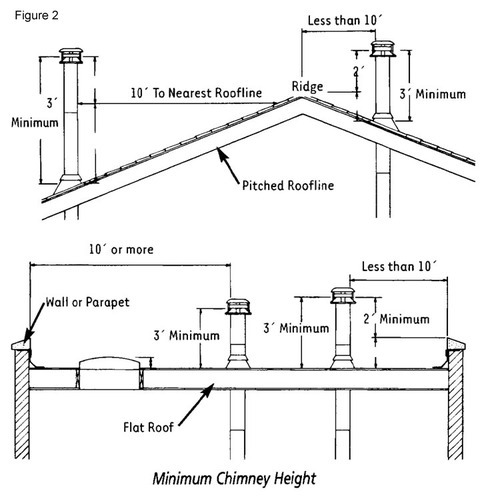
Roof pitch is easily calculated, and if you don’t know how, read my article Understanding and Calculating Roof Pitch. Also, you’ll need the horizontal distance between the peak and the edge of the high side of the pipe (see Figure 1) where you plan your roof penetration. We’ll go over the math a little further down; first let’s go over the 10 and 2 rule (see Figure 2).
Chimney height requirements
Most wood stove and factory-built fireplace manufacturers (and local building codes) will require that “the chimney must extend at least 2 feet above any portion of any structure within 10 feet (measured horizontally) and must extend at least 3 feet above the highest point of its roof penetration.”**
 Keep in mind there is generally a minimum chimney height requirement for the overall system (usually 15 feet, which sometimes includes connector pipe) that can affect the finished height of your chimney system. Other factors can influence the necessary height of the chimney such as “house stack effect” and high altitude. “Chimney height may need to be increased by 2-3% per 1000 feet of elevation.”** Although added height generally equates to stronger draft, there is a point where the system can become too long and over-drafting might occur, causing increased fuel consumption, hotter burn temperatures, and damage to your appliance.
 Now for the math lesson
Roof pitch is expressed as a ratio of rise over run. Rise is the length, expressed in inches, that the roofline travels upward over a 12-inch horizontal distance, which is known as the run. For example, a common pitch like 4/12 would mean that for every 12 inches of run, the roof rises 4 inches. So, if the 10-foot, 2-foot rule requires us to measure 10 feet to the nearest roofline, or structure, then we can use the rise to calculate a height requirement. Back to our example, over a run of 10 feet, the roof would rise 40 inches. Additionally, per our rule, we need to add 2 feet, or 24 inches, giving us a total height of 64 inches. So, take the top number of your roof pitch and multiply it by 10 then add 24, note Example 1. If your calculated required height falls below 36 inches (3 feet), then, as per our rule, it must be a minimum of 3 feet on the high side of the pipe penetration.
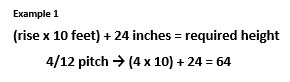 This calculation from Example 1 alone would give you a solid working height, but if you are close to your peak then you might have more pipe height than you actually need. If you can measure the horizontal distance between the peak and the edge of the high side of the pipe where you plan your roof penetration, you can use that to calculate your height in relation to your roof peak or ridgeline. Often you can measure this from inside the room where you are planning to install the stove or inside the attic space. Many people mistakenly think that the pipe always has to be 2 feet above the roof peak.
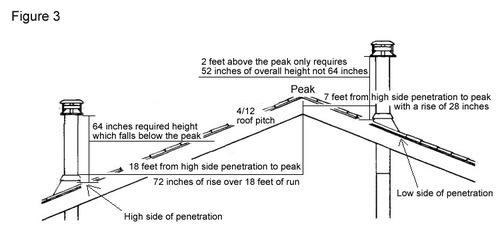 Let’s look at a couple of examples.
You are close to your eave and you find that your measurement is 18 feet from peak to penetration on a 4/12 pitch (see Figure 3). For 18 feet of run, you would have a rise of 72 inches. If the previous calculation results in the required height of 64 inches, we can see that the top of the pipe will not rise above the roof peak but would still meet the requirements of the rule. For the next example, you have a shorter chimney height. If your peak to penetration distance is 7 feet, you would have a rise of 28 inches. Per the 10 and 2 rule, once you are at the level of the peak, you only need to be 2 feet above it. So 28 inches plus 24 inches is a chimney height of only 52 inches. This reduces the actual required height by 12 inches from our previous calculation of 64 inches.
Please note that this rule doesn’t generally apply to pellet and gas vent systems. Hopefully this article helped you understand the 10 and 2 rule but if you still have questions, leave a comment or send us an email. We are always happy to help.
Written by Sean Summers, National Fireplace Institue (NFI) Master Hearth Technician - WoodstovePro.com
*This post is meant to be a guide so always consult your appliance owner’s manual and local code before planning your system.
**Woodburning Hearth System Reference Manual. Hearth Education Foundation. Dec. 2002 pg. 92
How to Select the Perfect Wood Stove
04/12/2017
Author: Sean Summers, NFI Master Hearth Certified Technician – WoodstovePro.com
A wood stove is more than a heating appliance—it's a statement piece, a source of comfort, and a long-term investment in your home’s efficiency. With so many brands, styles, and technologies available today, choosing the perfect stove can feel overwhelming. Homeowners often ask how to balance looks, performance, and build quality—and the good news is that modern stoves deliver on all three.
Below, we answer the most common questions about stove styles, materials, features to help you find the ideal match for your home.
What’s the difference between a cast iron vs steel stove?
One of the first decisions homeowners face is choosing between cast iron and steel construction. Both offer excellent heating capability, but each has unique benefits.
Cast Iron Stoves
- Beautiful, traditional designs with ornate detailing
- Retain heat longer after the fire dies down
- Distribute heat more evenly
- Often chosen for their aesthetic appeal
Steel Stoves
- Heat up quickly and begin warming the room faster
- Clean, modern styling
- Typically more budget-friendly
- Durable, simple, and efficient
Which is better?
It depends on your priorities. If you love classic style and long-lasting radiant heat, cast iron is a great choice. If you prefer modern lines and quick heat response, steel may be your perfect match. Both materials perform extremely well—especially when engineered by reputable brands.
Which brands offer the best mix of style and performance?
Two brands that consistently impress homeowners are Napoleon and Drolet.
Napoleon Wood Stoves
- Known for premium craftsmanship and elegant design
- Offer strong heating performance with refined aesthetics
- Available in both traditional and contemporary styles
- Packed with user-friendly features and clean-burn technology
Drolet Wood Stoves
- Exceptional value without compromising quality
- High-efficiency units ideal for whole-home heating
- Modern, practical designs built for long-term durability
- Popular among homeowners who want maximum heat for the budget
Both brands are EPA-certified, efficient, and trusted for reliability. You can’t go wrong with either—your choice will depend on style preference, budget, and heat output needs.
What size wood stove do I need?
Selecting the right size ensures comfort without overheating.
Consider:
- Home square footage
- Insulation levels
- Room layout and airflow
Small to medium homes often do well with stoves producing 30,000–50,000 BTUs, while larger or draftier homes may require 60,000 BTUs+.
Pro tip: Bigger isn’t always better. An oversized stove can make a room uncomfortably hot and lead to inefficiency.
What features matter most when choosing a stove?
Today’s wood stoves are designed with performance and convenience in mind. Look for:
- EPA certification for clean, efficient burning
- Large viewing windows for flame appeal
- Airwash systems that keep glass clean
- Easy-access ash pans for simple maintenance
- Blower kits to improve heat circulation
- Side or front loading options
These features enhance both performance and everyday usability.
How do I match a wood stove to my home’s style?
This is where function meets design.
Choose:
- Cast iron stoves for rustic, traditional, or historic homes
- Steel stoves for modern, minimalist, or farmhouse-style homes
- Soapstone or enamel finishes for added character and long-lasting warmth
With brands like Napoleon offering refined designs and Drolet focusing on clean, contemporary lines, you can easily find a stove that enhances your home’s aesthetic while keeping you warm.
Final Thoughts
Selecting the perfect wood stove means balancing style, performance, and trusted engineering. Whether you're drawn to the timeless beauty of cast iron or the sleek efficiency of steel, you can find the perfect wood stove to enhance your home.
If you need help choosing the right size, style, or material, our certified hearth professionals are here to guide you. Contact us at 888-418-0005 or info@woodstovepro.com.
More Articles
- Replacing a Fireplace Blower Fan: Symptoms, Options, and Fit Tips
- Electric Fireplace Placement Guide: Wall-Mount, Built-In, or TV Stand?
- Pellet Insert Maintenance Tips: Cleaner Burns and Fewer Shutdowns
- How to Improve Wood Stove Efficiency: Burn Hotter, Cleaner, Longer
- Best Fireplace Screens for Safety: Styles, Fit Tips, and Placement
- Gas Logs: Vented vs Vent-Free Logs (Realism, Heat, and Safety)
- Class A Chimney System Components: Tees, Supports, and Why They Matter
- Gas Insert Buying Guide: Sizing, BTUs, and Choosing the Right Model
- Wood Stove Break-In Guide: First Fires, Curing Paint, and What to Expect
- Chimney Flashing and Roof Leaks: How to Spot Problems Early
- Electric Fireplace Operating Costs: Do Electric Fireplaces Use a Lot of Electricity?
- Clearance to Combustibles Explained: The Safety Rule Homeowners Miss
- Pellet Quality Matters: How Pellets Affect Heat, Ash, and Maintenance
- Chimney Caps 101: Which Type Do You Need and Why?
- Propane vs Natural Gas Fireplaces: What to Know Before You Choose
- Fireplace Glass Doors: Benefits, Fit Tips, and Safety Basics
- How to Heat Your Home Safely During Power Outages
- Winter Fireplace Checklist: Is Your Hearth Ready for Heating Season?
- When to Replace Your Wood Stove Gaskets (and How to Do It Right)
- The Pros and Cons of Vent-Free Gas Fireplaces
- EPA Certified Wood Stoves Explained: What It Means and Why It Matters
- Top Fireplace Accessories That Make Heating Safer and Easier
- Wood Stove Placement Tips for Maximum Heat Distribution
- Pellet Stove Maintenance 101: Common Questions Answered
- Choosing Between Gas Logs and Gas Inserts
- All About Chimney Liner Types and When to Replace Them
- 7 Signs It’s Time to Replace Your Fireplace or Stove
- Wood vs. Pellet Stoves: Which Fits Your Lifestyle?
- Understanding Double-Wall vs. Single-Wall Stove Pipe
- How to Keep Pets and Kids Safe Around Fireplaces
- 5 Signs It’s Time to Replace Your Chimney Pipe
- How to Choose the Right Wood Stove for Your Home Size
- Top 10 Fireplace Accessories Every Homeowner Needs This Season
- Your Burning Questions Answered
- Tax Credit Up to $2000!
- Gas Fireplaces 101: Everything You Need to Know Before You Buy
- How to Store and Season Firewood the Right Way
- Electric Fireplaces: Frequently Asked Questions Answered
- Chimney Pipe 101: Frequently Asked Questions Answered
- Wood Burning Fireplace Safety Tips for the Holidays
- Is All Stainless Steel Chimney Pipe the Same? What to Know Before You Buy
- Understanding and Calculating Roof Pitch
- The 10-Foot 2-Foot 3-Foot Rule
- How to Select the Perfect Wood Stove
© 2006-2026 E-Prosites